Tuesday, March 31, 2009
Teamwork
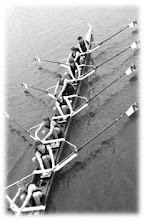
There are plenty of sports that depend on teamwork just as much as rowing: football, lacrosse, soccer, basketball, ice hockey, curling, volleyball, water polo, frisbee, paintball, rugby, and many others. In an orchestra, your fellow musicians are your team; and in the work place, your co-workers. To be part of a team simply means that you rely on each other to achieve a common goal.
Why, then, is rowing often considered the "ultimate" team sport? What makes being on a crew unique enough that its level of teamwork supersedes all other sports?
First, in terms of training and exertion, rowing is often compared with cross-country skiing, outdoor cycling, swimming, and running. These sports all require tremendous amounts of endurance, aerobic capacity, and physical strength. They challenge the whole body, every muscle, for the duration of the activity. But these other sports all focus on the individual, whereas rowing focuses on the boat. Therefore, rowers must rely on the endurance, aerobic capacity, and strength of the rowers around them.
Second, every stroke a rower takes is a simple choice: how hard do I pull? Think back to your last 2k erg piece when your body was telling you to give up but you willed yourself to continue. Your quads were in pain but you knew the finish line was only 3 minutes away. You chose to finish (or not). In the boat, you have this decision, too; and you share this decision with all the other rowers. But it is easier to hide this decision behind a deceptively large, frothy puddle, a tense face, or a primal exhale. Therefore, each rower must trust in their fellow oarsman. There must be confidence in each other.
Third, all rowers do the same thing. All of the examples of teams above consist of many individuals with unique roles. The 11 players on a soccer field, for instance, each have a distinct position and mission that, if coordinated, will help the team win. Musicians, also, play on various instruments from various parts to create a total symphony. In the boat, however, every rower is doing the exact same thing. Yes, there are different seat positions, but they are mostly determined by strength, size, and weight. Therefore, rowing is an activity shared by the entire team equally.
Is the teamwork on a crew "ultimate?" Maybe yes, maybe no. But there is no question that rowing embodies many unique elements of teamwork that set it apart.
Wednesday, March 25, 2009
Saturday Afternoon Jog 3/28
Introducing the Grand Boulevard Loop
Meet outside the HS New Cafe entrance at 2:30pm
Distance: 4.3 miles

Meet outside the HS New Cafe entrance at 2:30pm
Distance: 4.3 miles

Tuesday, March 24, 2009
US Men's 8 Technique
The following pictures are all of the United States' Men's 8 training before the Olympics. The US finished 3rd (5:25.34) in Beijing behind Canada (5:23.89) and Great Britain (5:25.11). The memebers of the Men's 8 were: Bryan Volpenhein, Josh Inman, Steven Coppola, Daniel Walsh, Wyatt Allen, Micah Boyd, Matt Schnobrich, Beau Hoopman, and coxswain Marcus McElhenney. Here's a look at their technique:
At the catch - look at their grips, angle of their arms, back splash, high chest, connection of the leg drive, and hand levels.


Through the drive - look at their precision, leg drives, straight arms, lay back, and posture.


On the recovery - look at the outside arm, the wrist, the hands away before the legs come up, and the balance of the boat.


Courtesy of Row2k
Monday, March 23, 2009
Precisions on the Leg Drive
Here's a brief video of the Australian Men's Eight 2 months before the Olympics. Watch carefully at the speed of their leg drives and that that is where most of the pressure is being applied.
Courtesy of YouTube
Courtesy of YouTube
Subscribe to:
Posts (Atom)