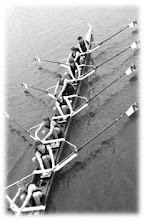
It is time for the Niskayuna Varsity Boy's team to move beyond the idea of "timing" and more towards that of "precision."
Timing, for all intents and purposes, limits most rowers to two points in the stroke: catch and finish, the beginning and the end. But the catch and finish, though important, account for only a very brief part of the stroke cycle - mere hundredths of a second. Unfortunately, so much else that happens in between, including drive speed, body swing, arms away, and breathing, is often lost to this focus on just the catch and finish.
Precision, on the other hand, is what most coaches mean when they talk about timing. Precision is timing, synchronicity, body angles, and power all wrapped up into one. Precisions is:
driving the legs down together from the catch;
waiting to open your body with the rest of the boat;
swinging at the same time;
matching your body angles at the finish;
pushing the arms away at the same speed;
leading the recovery with your body; and
controlling your legs up the recovery;
balancing your reach over the rigger;
inhaling just before taking the catch; and
exhaling right at the finish with your crew;
applying consistent pressure every stroke; and
accelerating as one boat; and, of course
getting the blade in and out of the water together.
Below is a good example from the US Marine Corps of precision.
Courtesy of YouTube and not an endorsement of the US Marine Corps
For the most part, rowers should be breathing twice per stroke - whether at a rate 18 or a rate 40. The following sequence of pictures should help you understand where to breathe during the stroke cycle:
As you prepare to contact colleges or other coaches (for rowing camps or junior national team interest), it is important that you have a resume of your rowing history ready. This is pretty easy to compose with a little research.
You will want to include: your personal information (height, weight, and erg times), your rowing accomplishments (results and boats rowed in), your experiences (races and regattas), and your personal interests.
Below is a sample resume that should help get you started.